 Photos – Stephen Godfrey
The Blood Moon Theatre is an inauspicious venue to say the least. While many of the artistically greatest theatres in this country have humble beginnings as former tomato sauce factories, railway workshops and other converted industrial sites, this tiny stage crammed into the backroom of a pub-come-nightclub, with structural pillars obstructing part of its asymmetrical makeshift auditorium lined with brutally uncomfortable folding chairs, is evocative of student theatre. Indeed, the rough-and-ready makeshift performance spaces of a few venerable university drama societies spring immediately to mind here, as does the not dissimilar smell-of-an-oily-rag production values in these stock-looking costumes and rather amateurish blackout scene-changes.
All that said, I was rather taken aback by the high quality of the acting from this entirely unfamiliar cast, and the fact that, for all the limitations of this “cheap and cheerful” production, they did not let down Tom Stoppard’s masterful text one jot. This is, of course, probably the most famous and popular metatheatrical black comedy of the 20th Century, in which two of the least important characters from arguably the most famous (and itself metatheatrical) play in the English language are helplessly and often hilariously floundering through a prolonged existential crisis.
Rosencrantz and Guildenstern Are Dead is an evergreen favourite for those who enjoy crackling wordplay and stinging absurdist irony, shot through with accessible philosophical musings and a heavy dose of archly self-aware humour about the nature of theatre and actors. This comes courtesy of the titular minor roles from Hamlet encountering a troupe of performers, whom the Danish prince later hires to perform the play-within-the play whereby he hopes to catch the conscience of the king.
While a working knowledge of Shakespeare’s most revered tragedy is something of a prerequisite for following Stoppard’s inverse use of Hamlet, Ophelia, Claudius et al. as minor characters, dipping in and out of the seemingly aimless pontification of Rosencrantz and Guildenstern – here treated as this play’s leads – it is nevertheless possible to follow. These trailing lines of dialogue and plot threads imply that the events of Hamlet are taking place offstage, while we are watching what was, in turn, previously happening ‘in the wings’ and unimportant to the Bard. Unimportant, that is, unless of course you happen to be these seemingly disposable, ill-fated friends of the Prince, and this is that story, from their anxiously befuddled perspective.
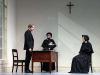
Stoppard’s play works on many other levels, and while this is a modest production, its strong cast makes sure this fiercely intellectual and highly digressive tragicomedy never seriously lags, bringing great energy and wit to their roles. The choice to cross-cast the play with inverted genders is perhaps not the most creative or profound choice (indeed, this is not even the first gender-switched production of the play I have seen). Nor is its significance particularly well-articulated by the otherwise conventional Elizabethan production design either, other than perhaps as a mirror to the topsy-turvey nature of the play’s character focus, relative to its Shakespearean source text. Moreover, it is inconsistent in its application, with the lead roles played by women in character-appropriate masculine garb, while everyone else wears (the actors’) gender-appropriate costumes, regardless of playing characters of the opposite sex. Furthermore, one lone role remains unaltered, although it is unclear whether this is intended as an irony on his status as cross-dressing performer, or merely out of discomfort for having the character being portrayed by a woman, being as he is the target of repeated sexual exploitation jokes. Either way, it sticks out as something of a puzzling inconsistency.
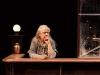
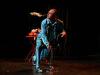
Pleasingly, however, despite this arguably ill-conceived gimmick, the cast is excellent, and extremely well suited to their roles, regardless of gender. Emily Burke, and Sarah Plummer impress as Hamlet and Claudius, while David McLaughlin and Lauren Crew demonstrate excellent comic timing with their largely mute roles as Alfred and the Tragedian. Amanda Maple-Brown is strikingly good as the Player, in an appropriately theatrical turn that finely captures the haughty campiness of the character, whilst letting the occasional chinks of dark pathos shine through while portraying Stoppard’s less than flattering portrait of professional actors.
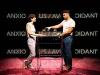
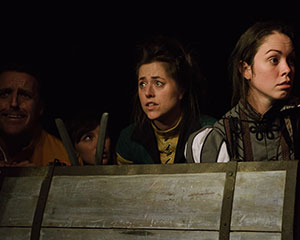
Inarguably though, the central pair are the most important roles, and the ones most crucial to be well cast. While one of the central jokes of the play is that no-one can tell Rosencrantz and Guildenstern apart or, at any rate remember which is which – including, apparently, each other – the characters on the page are actually quite distinct. It is the failing of some past productions to play up to their supposed indistinguishability, instead of highlighting the differences via differentiating the actors’ respective performances. Emilia Stubbs Grigoriou is all angst and frustrated intellect as Guildenstern, delivering a striking performance that conveys a veneer of brittle smugness shot through with moments of surprisingly moving emotion, as the existential panic really starts to set in. If Guildenstern is presented here as the straight man, by contrast Krystiann Dingas expertly plays the fool, as a buffoonish Rosencrantz. Her performance is full of uproariously glazed expressions and uncomprehending furrowed brows, between bouts of enthusiastically motormouthed idiocy.
For some, Dingas’ performance may come across as too broad in contrast to Stubbs Grigoriou’s more restrained and elegant delivery of Stoppard’s wry dialogue, yet I would argue that the joy is in the contrast. Whether the credit should go to the otherwise serviceable direction of Chris McKay, the initial casting choices, or simply the actors’ own chemistry, this presentation of Guildenstern and Rosencrantz as a sharply differentiated classic odd-couple works well against the running gag that no-one knows who is who. Perhaps one of the nicest moments of their performance is also the most subtle, in which the otherwise identically-dressed pair swap the one-shouldered versus two-shouldered styles in which they respectively wear their capes, unobtrusively in the middle of a scene. This little nod towards their confused duality despite clear distinctions in personality is delightfully understated, and another indication of this simple production’s surprising strength.
Although you will undoubtedly have bigger and better presentations of Stoppard’s perennial crowd-pleaser to choose from in the not too distant future, this is a surprisingly solid rendition with some disarmingly good performances which, if this lower end of the independent theatre scene is not too much of a turn-off for you in terms of venue comfort and production value, I would even go so far as to say it should not be missed.
Furies Theatre presents
Rosencranz and Guildenstern are Dead
by Tom Stoppard
Director Chris McKay
Venue: The Blood Moon Theatre | 24 Bayswater Rd, Kings Cross NSW
Dates: 10 – 21 May 2016
Tickets: $27 – $22
Bookings: www.trybooking.com/KGME